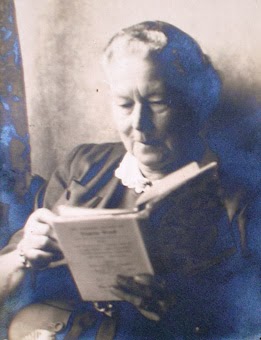
(from Mary Knox)
My parents' friendship with 'Aunt Lisbet' is one of my earliest memories. She was a most remarkable person: intellectual, artistic, a little intimidating to strangers but a loving friend.
From a well-off family in Germany, she was happily married until her husband was involved in a ballooning accident and drowned in the Baltic sea. She turned to the study of painting and did extremely well; by the time post-World-War 1 inflation in Germany destroyed her financial security, she was beginning to earn a living from the sales of her paintings.
In 1923 she made the courageous decision to travel the world, supporting herself by holding exhibitions and selling paintings and prints, and giving talks about Germany and about her travels. After spending time in the Dutch East Indies, South and Central America, Africa and finally Australia, she came to New Zealand - and World War 2 broke out.
As an 'enemy alien' she came under considerable suspicion. I remember my mother telling me that in one official interview Lisbet had pointed out that some of the prints in her travelling exhibition were of paintings by modern artists who had been banned by Hitler. She was asked to bring some to the office next time. She arranged them around the room, and the official walked round and looked at each. Finally he said, 'Well, for the first time in my life I find myself in agreement with Mr Hitler.'
She never returned to Germany, but lived the rest of her life in Mahina Bay near Eastbourne among her wide circle of friends. She was a notoriously bad cook, but we are fond of her Apfelküchen.
Elisabet Delbrück's Apfelküchen
Line a shallow pan with short pastry, bought or homemade.
Arrange slices of apple in overlapping rows, and sprinkle with a mixture of sugar and cinnamon. Bake in a medium oven till cooked.
Margaret Sutherland has written a book about Lisbet, One Artist on Five Continents.
Saturday, February 8, 2014
Tuesday, January 7, 2014
Auntie Jean's Apple Macaroon
(From Mary Knox)
My dear Auntie Jean was a good cook. She had to be - Uncle George was a judge, and his fellow judges and other bigwigs had to be entertained at dinner parties. On one memorable occasion she served up a lovely dinner: and when they had all gone home she discovered the serving dish of peas still sitting in the warming drawer!
But for more normal family occasions she had some unassuming recipes. This one has become a great favourite in our family. It's the easiest apple dessert I know. You can tell how much we love it from the state of the recipe card.
Method:
Peel and slice 5-6 apples (apples were smaller in those days in Canada, so you may only need 3 or 4). Put them in a buttered pie dish.
Sprinkle over them a scant half cup of sugar, with a little cinnamon mixed into it.
Cream 4 tablespoons of butter (that's about a quarter of a cup or 2 ounces). Beat in a small half cup of sugar then 1 egg, then half a cup of flour sifted with a pinch of salt. Spread it over the apples.
Bake for 30 minutes in a moderate oven.
Variations:
This has a slightly crunchy top. If you prefer a more cakey top, add a quarter of a teaspoon of baking powder to the flour. I sometimes put in a few blackberries. Or you can use plums instead of apples - in that case increase the sugar on the fruit to 3/4 of a cup, use slightly more flour in the mixture, and omit the cinnamon. I plan to try it with apricots some time.
My dear Auntie Jean was a good cook. She had to be - Uncle George was a judge, and his fellow judges and other bigwigs had to be entertained at dinner parties. On one memorable occasion she served up a lovely dinner: and when they had all gone home she discovered the serving dish of peas still sitting in the warming drawer!
But for more normal family occasions she had some unassuming recipes. This one has become a great favourite in our family. It's the easiest apple dessert I know. You can tell how much we love it from the state of the recipe card.
Method:
Peel and slice 5-6 apples (apples were smaller in those days in Canada, so you may only need 3 or 4). Put them in a buttered pie dish.
Sprinkle over them a scant half cup of sugar, with a little cinnamon mixed into it.
Cream 4 tablespoons of butter (that's about a quarter of a cup or 2 ounces). Beat in a small half cup of sugar then 1 egg, then half a cup of flour sifted with a pinch of salt. Spread it over the apples.
Bake for 30 minutes in a moderate oven.
Variations:
This has a slightly crunchy top. If you prefer a more cakey top, add a quarter of a teaspoon of baking powder to the flour. I sometimes put in a few blackberries. Or you can use plums instead of apples - in that case increase the sugar on the fruit to 3/4 of a cup, use slightly more flour in the mixture, and omit the cinnamon. I plan to try it with apricots some time.
Labels:
Aunties,
Baking,
Desserts,
Fruit,
Quick and easy
Wednesday, December 25, 2013
Not-as-good-as-last-year’s Christmas pudding
(From Johanna Knox)
Makes two good-sized puddings – one for
your family, and one to give away.
This pudding recipe has travelled down at
least five generations. My great-great grandmother made it; perhaps it goes back
further.
Each generation adapted it or added to it. BUT
the vital secret ingredient for 70 years or more has been that you must, at
some point, say, ‘I’m sure it isn’t as good as last year’s.’
How this tradition came to be, no one now knows, though I wonder if it began with my grandmother (left), who was of a very anxious disposition.
Family members are divided over whether you say it when tasting the batter, or as you’re serving it cooked. But whichever way, it’s imperative.
Ingredients:
1 pound butter
¾ pound sugar
1 ¼ pounds flour
1 ½ teaspoons baking soda
¼ pound slivered or chopped almonds
¼ pound peel
1 packet crystallised ginger (chop if big
bits)
1 packet raisins
1 ½ pounds dates, chopped
½ pound currants
1 – 1 ½ pounds sultanas
¼ pound ground almonds
8 eggs
1 dessertspoon full of golden syrup
A wine glass of brandy
Vanilla and almond essence to taste
Prepare two large squares of unbleached
calico: wash or boil ahead of time to get any filler out, and dry.
Method:
Cut up butter into small pieces and use
fingers to rub in sugar, flour and baking soda.
Mix together well: almonds, peel, crystallised
ginger, raisins, dates, currants, sultanas, and ground almonds. Stir these into
the rubbed butter mix.
In a separate bowl, mix eggs, golden syrup,
brandy, vanilla essence and almond essence.
Pour liquid ingredients into dry
ingredients and mix well,
Flour the calicao squares very well,
rubbing flour into and in between the fibres.
Dump half the pudding mix into the middle
of one cloth, and tie it up in a bundle – with string or a strip of cloth,
leaving a little space for expansion at the top. The string should be tied very tightly. Make
a loop for removing the pudding later.
Do the same with the other half of the
pudding mix – into the second square of calico.
Fill a stockpot half full of water, with an
old plate in the bottom of the pot to prevent burning.
Bring to the boil. Put in one pudding.
Boil for 6 hours, topping up the water when
necessary and keeping it on a gentle boil all the time. (The pudding will float
so you won’t ever get the water completely covering it.)
After 6 hours, remove pudding from
still-boiling water and hang it.
Repeat with the second pudding, or if you
have two stockpots, do them at the same time.
Hang puddings for a week or more.
To serve:
On the day of serving, retie the pudding as
it will have shrunk, and don’t leave any expansion space at the top – retie it close
to the pudding.
Reboil for an hour or more.
Take it out of the calico and put it on a
plate. Pour warmed brandy over
(about a quarter to half a cup) and set alight before bringing to table.
Serve with brandy sauce and whipped cream.
There will be a white crust on the outside,
which traditionally most of the family likes when hot, but if leftovers are served
later cold, they remove the crust.
When cold it’s nice with golden syrup.
Sunday, April 1, 2012
Small acts of thrift
(From Johanna Knox)
My Canadian great-grandmother used to say, ‘Look after the cents, and the dollars take care of themselves.' It was an expression of her thrifty approach to life which is still repeated in my family today ... the saying that is, not necessarily, I'm sorry to say, the approach itself!
My Canadian great-grandmother used to say, ‘Look after the cents, and the dollars take care of themselves.' It was an expression of her thrifty approach to life which is still repeated in my family today ... the saying that is, not necessarily, I'm sorry to say, the approach itself!Even the smallest acts of thrift were important to my great-grandmother. I imagine they were to many women of her time. Some of these small acts were passed down, and became family habits.
Like the butter wrappers that my great-grandmother, then my grandmother and my mother saved, so that no part of that gold was wasted. Neatly folded in the top compartment of the fridge door, a wrapper could always be brought out when a pie dish or baking tray needed greasing. Did most of us have mothers or grandmothers who did this?
In my grandmother’s old Mennonite Community Cookbook (by Mary Emma Showalter), there is a ‘Household Hints’ section containing this tip:
‘Before discarding the empty catsup bottle, pour some vinegar into the bottle and use in making French dressing.’
What a neat trick for any sauce bottle when it gets to that frustrating stage where you can see all that perfectly good stuff at the bottom but no matter how much you tip or shake or bang - it WON’T. COME. OUT.
Another family thrift tradition: When my mother made schnitzel or crumbed fish, after all the pieces were egged and crumbed she tipped the few leftover breadcrumbs into the blob of leftover egg, and fried the mix as a ‘crumb pancake’. There was only ever enough for one tiny pancake, but in spite of its meagre size – or more likely because of it – it was my favourite part of the meal.
(Years later, I seized on the way my own son loved crumb pancakes and began to make them deliberately for him, by the bowlful. We got bored of them and went off them, and I learned that some traditions should not be tampered with!)
What small acts of thrift have been passed down and become habits in your family?
Sunday, March 18, 2012
Cheese Potato Pie
(from Nicki Levy)
I served it up, the boys took one bite and, in unison, a resounding "yuk". I was devastated and, as a result of having so much left over, I ate it all.
I think the main problem was that I hardly ever serve up or cook with cheese or butter anymore and I think it was just too rich and oily.
If you're considering making this, which I recommend you do even though I haven't made it sound too appetising, I would experiment with reducing the cheese and butter and maybe adding a spice or two. It could be delicious as a side dish to all sorts of meals and even made into potato pancakes.
1. 750 gm potato (cooked & mashed).
2. Chop 1 onion & brown in 50 gm butter.
3. Stir in 3 tbsp flour, pinch salt & pepper.
4. Cook 1-2 min while stirring.
5. Gradually stir in 1.5 cups milk & cook till bubles & thickens.
6. Remove from heat & add 1/2 tsp oregano & 1.5 cup grated cheese, stir till cheese melted.
7. Add to mashed potato & mix till smooth. Bake in greased oven proof dish.
Mum used to make this for us and I remember Adam, Emma and I eating mountains of it. There was a period of our lives when we asked for it a lot.
When I made this for my boys recently, I spent the day building it up - I was so excited about eating it that I went a little overboard.
By the time it came to serve up dinner, I was almost squealing with the memory of how much we used to love this.
I served it up, the boys took one bite and, in unison, a resounding "yuk". I was devastated and, as a result of having so much left over, I ate it all.
I think the main problem was that I hardly ever serve up or cook with cheese or butter anymore and I think it was just too rich and oily.
If you're considering making this, which I recommend you do even though I haven't made it sound too appetising, I would experiment with reducing the cheese and butter and maybe adding a spice or two. It could be delicious as a side dish to all sorts of meals and even made into potato pancakes.
1. 750 gm potato (cooked & mashed).
2. Chop 1 onion & brown in 50 gm butter.
3. Stir in 3 tbsp flour, pinch salt & pepper.
4. Cook 1-2 min while stirring.
5. Gradually stir in 1.5 cups milk & cook till bubles & thickens.
6. Remove from heat & add 1/2 tsp oregano & 1.5 cup grated cheese, stir till cheese melted.
7. Add to mashed potato & mix till smooth. Bake in greased oven proof dish.
Saturday, March 10, 2012
Pickled Vegetables and Caramel Pudding (not TOGETHER!!)
(from Paulette Robinson)
These recipes are another two from Paulette. Her mother, Carole Charles, was also my Auntie Carole. Though not an actual aunt, she was a part of my life and my family from the day I was born. She and my father had grown up together in Wellington; they were like cousins, and Paulette and I are the same way. When my mum died in 2004, Auntie Carole was one of the rocks in my life. When she too was diagnosed with terminal cancer, only two years after mum, the sadness was indescribable. The loss of Carole was the loss of another of the mums of the group of families I grew up with. It was the end of an era of the friendship of that group of mothers, who supported each other, cooked together, and argued together too! These recipes are part of the book that Paulette made when she decided to start collecting recipes from family and friends. Carole wrote them out for her, and my favourite part is right at the bottom where she has written a note to Paulette.
Not necessarily to be eaten together, enjoy Carole's pickled vegetables and caramel pudding!
(I have deciphered Carole's handwriting - and that was not easy! - PLEASE check her copy and if anyone sees a mistake, let me know straight away!!).
Emma
Pickled Vegetables
Boil 2 pints white vinegar, 2 cups water, 2 cups sugar, 1tsp salt.
Cool
Chop peppers, carrots, celery, cucumber, cauliflower, zucchini, beans.
Fill jars loosely with the vegetables.
Add bay leaf, crushed garlic clove, a little more salt.
Pour over liquid.
Keep in fridge.
Leave four days, at least.
Caramel Pudding
Vitamise:
1 cup brown sugar
2 Tbsp flour
2 egg yolks
2 cups milk
A spot of vanilla
Bring to the boil stirring.
Add 1 Tbsp butter.
Boil for 2 hours.
When cold, add beaten egg whites.
These recipes are another two from Paulette. Her mother, Carole Charles, was also my Auntie Carole. Though not an actual aunt, she was a part of my life and my family from the day I was born. She and my father had grown up together in Wellington; they were like cousins, and Paulette and I are the same way. When my mum died in 2004, Auntie Carole was one of the rocks in my life. When she too was diagnosed with terminal cancer, only two years after mum, the sadness was indescribable. The loss of Carole was the loss of another of the mums of the group of families I grew up with. It was the end of an era of the friendship of that group of mothers, who supported each other, cooked together, and argued together too! These recipes are part of the book that Paulette made when she decided to start collecting recipes from family and friends. Carole wrote them out for her, and my favourite part is right at the bottom where she has written a note to Paulette.
Not necessarily to be eaten together, enjoy Carole's pickled vegetables and caramel pudding!
(I have deciphered Carole's handwriting - and that was not easy! - PLEASE check her copy and if anyone sees a mistake, let me know straight away!!).
Emma
Pickled Vegetables
Boil 2 pints white vinegar, 2 cups water, 2 cups sugar, 1tsp salt.
Cool
Chop peppers, carrots, celery, cucumber, cauliflower, zucchini, beans.
Fill jars loosely with the vegetables.
Add bay leaf, crushed garlic clove, a little more salt.
Pour over liquid.
Keep in fridge.
Leave four days, at least.
Caramel Pudding
Vitamise:
1 cup brown sugar
2 Tbsp flour
2 egg yolks
2 cups milk
A spot of vanilla
Bring to the boil stirring.
Add 1 Tbsp butter.
Boil for 2 hours.
When cold, add beaten egg whites.
Saturday, March 3, 2012
Phil Levy - 30th July 1935-3rd March 1987
(from Emma Levy)
Today is 25 years since my dad died. This weekend's blog is a special tribute him. Although, 25 years later, my memories of him are not as strong as I wish they were, the essence of him still is. He was a man who adored his family. He loved his friends, and loved having them over and playing the host, particularly introducing them to a new wine or whisky that they MUST try.
His parents ran a clothing store on the main road of Lower Hutt, which he later ran. That meant he was pretty available during the day - he dropped me off at school some days, came to school events, and the shop was a place we frequented. As a kid I remember playing there, running through clothes and getting told off. He had a store in Lower Hutt and one in Wainuiomata, which we would go to less frequently, but it was in a mall that had a sweets shop that sold meringues in the shapes of animals, and we were allowed to choose one each time we were there. (And he had a shop assistant called Judy who, according to dad, wore her pyjamas under her floor length skirt on very cold days). There were many stories that dad told that didn't sound likely, but we never knew for sure.
Everyone in Lower Hutt seemed to know him. We'd walk down High St and people would call out "Hi Phil, how's the family?". They'd stop and have a chat for what seemed like an eternity, and when they finally finished and walked away, I'd say "Who was that?" and he'd say "I don't know." Every time I would shriek and ask how he could talk to someone for THAT long about their lives and not know who they were. But he could.
Dad was a great food lover - yes it could be said that he over-indulged at times - and particularly loved all the foods that came out only once a year for Jewish festivals. A special love was his mother's Maztah Balls - these are balls made out of the "large square crackers" called Matzah, that Jews eat at Passover (Pesach). They are VERY yummy in a bowl of chicken soup. As his mother was ageing, she called up my mother (not her own son) to learn how to cook them in case she died sometime soon. Although she frequently considered dying very soon, she was as tough as nails and was a strong presence in our lives. It was the death of my dad, her only son, that proved too much for her, and she passed away four weeks after he did. This recipe, therefore, is a salute to them both - the mother who made the maztah balls, and her son who loved to eat them.
Today, 3rd March, I remember my dad, Phil, with love.
Matzah Balls
4 sheets Matzah
1 good-sized onion, chopped
Salt and pepper
1 teacup Matzah Meal
1 egg
1/2 tsp nutmeg
1. Soak matzah, then drain in sieve.
2. Press water out with back of spoon.
3. Leave to dry while frying onion.
4. Take off heat.
5. Add egg, salt & pepper, and ½ tsp nutmeg.
6. Mix well.
7. Add matzah meal until it's the right consistency for rolling.
8. Roll into balls with wet hands and roll balls into matzah meal.
9. Put on flat dish and refrigerate.
10. Later, drop the balls into boiling, salted water until they rise to the top.
11. Do a few (3-4) at a times as to keep the water boiling.
12. As soon as they rise, remove with spoon.
The fabulous photo above was sent in by Raoul Ketko, a lifelong friend of my dad. Raoul said that naturally they had to sample the wine to ensure it would complement the meal properly. Read the comments section below for Raoul's memories of Phil and their friendship.
Today is 25 years since my dad died. This weekend's blog is a special tribute him. Although, 25 years later, my memories of him are not as strong as I wish they were, the essence of him still is. He was a man who adored his family. He loved his friends, and loved having them over and playing the host, particularly introducing them to a new wine or whisky that they MUST try.
His parents ran a clothing store on the main road of Lower Hutt, which he later ran. That meant he was pretty available during the day - he dropped me off at school some days, came to school events, and the shop was a place we frequented. As a kid I remember playing there, running through clothes and getting told off. He had a store in Lower Hutt and one in Wainuiomata, which we would go to less frequently, but it was in a mall that had a sweets shop that sold meringues in the shapes of animals, and we were allowed to choose one each time we were there. (And he had a shop assistant called Judy who, according to dad, wore her pyjamas under her floor length skirt on very cold days). There were many stories that dad told that didn't sound likely, but we never knew for sure.
Everyone in Lower Hutt seemed to know him. We'd walk down High St and people would call out "Hi Phil, how's the family?". They'd stop and have a chat for what seemed like an eternity, and when they finally finished and walked away, I'd say "Who was that?" and he'd say "I don't know." Every time I would shriek and ask how he could talk to someone for THAT long about their lives and not know who they were. But he could.
Dad was a great food lover - yes it could be said that he over-indulged at times - and particularly loved all the foods that came out only once a year for Jewish festivals. A special love was his mother's Maztah Balls - these are balls made out of the "large square crackers" called Matzah, that Jews eat at Passover (Pesach). They are VERY yummy in a bowl of chicken soup. As his mother was ageing, she called up my mother (not her own son) to learn how to cook them in case she died sometime soon. Although she frequently considered dying very soon, she was as tough as nails and was a strong presence in our lives. It was the death of my dad, her only son, that proved too much for her, and she passed away four weeks after he did. This recipe, therefore, is a salute to them both - the mother who made the maztah balls, and her son who loved to eat them.
Today, 3rd March, I remember my dad, Phil, with love.
Matzah Balls
4 sheets Matzah
1 good-sized onion, chopped
Salt and pepper
1 teacup Matzah Meal
1 egg
1/2 tsp nutmeg
1. Soak matzah, then drain in sieve.
2. Press water out with back of spoon.
3. Leave to dry while frying onion.
4. Take off heat.
5. Add egg, salt & pepper, and ½ tsp nutmeg.
6. Mix well.
7. Add matzah meal until it's the right consistency for rolling.
8. Roll into balls with wet hands and roll balls into matzah meal.
9. Put on flat dish and refrigerate.
10. Later, drop the balls into boiling, salted water until they rise to the top.
11. Do a few (3-4) at a times as to keep the water boiling.
12. As soon as they rise, remove with spoon.
The fabulous photo above was sent in by Raoul Ketko, a lifelong friend of my dad. Raoul said that naturally they had to sample the wine to ensure it would complement the meal properly. Read the comments section below for Raoul's memories of Phil and their friendship.
Sunday, February 26, 2012
Brandy and Chocolate Ice-cream
(from Nicki and Emma Levy)
This delectable ice-cream was a favourite of our mum's, and is SO creamy and delicious. No, we weren't brandy drinkers as children, but we loved this!! It is REALLY easy to make and always impressed dinner party guests. Enjoy!
3 egg whites
1/2 cup sugar
300ml whipped cream
2 tbsp brandy
1 dspn cocoa
little hot water
1. Beat egg whites stiffly.
2. Add sugar & beat well.
3. Add whipped cream. Stir lightly.
4. Divide mixture into two.
5. Add brandy to one half & cocoa melted in the hot water to the other half.
6. Put alternate spoonfuls into ice-cream tray.
Do not stir or mix.
Freeze.
This delectable ice-cream was a favourite of our mum's, and is SO creamy and delicious. No, we weren't brandy drinkers as children, but we loved this!! It is REALLY easy to make and always impressed dinner party guests. Enjoy!
3 egg whites
1/2 cup sugar
300ml whipped cream
2 tbsp brandy
1 dspn cocoa
little hot water
1. Beat egg whites stiffly.
2. Add sugar & beat well.
3. Add whipped cream. Stir lightly.
4. Divide mixture into two.
5. Add brandy to one half & cocoa melted in the hot water to the other half.
6. Put alternate spoonfuls into ice-cream tray.
Do not stir or mix.
Freeze.
Sunday, February 19, 2012
Thanks Nana
(from Becs Addison)
Today's recipe is a very special one, sent to us from a fellow blogger. Becs Addison is a woman of many talents - using recycled materials to make wonderful creations that you can find in her blog, Born Again Creations. Bec's most recent entry in her own blog was the story of her Nana's bran muffins, which she has shared with Pass It On. Do check out her blog (you'll never look at your old tea towels in the same way again).
Bec's blog: http://bornagain-creations.blogspot.com.au/
Bec's Facebook page: https://www.facebook.com/pages/Born-Again-Creations/121505087928245
When I was a girl my mum took my sisters and I to visit our maternal grandmother in Timaru in the Canterbury region of New Zealand. We stayed in her little brick house with the outdoor toilet and sturdy kitchen table for a few days catching up on family news and as always with Nana Joyce, laughing a lot.
One evening we were all a little peckish after dinner so Nana whipped up some bran muffins to fill the gap before bed. They were the best muffins I'd ever tasted and even as a child I just knew I had to get her to write down the recipe for me. And she did.
We haven't had much bran in the kitchen in the last few gluten free years. I hadn't really given this recipe any thought until one day last week I decided that one of Nana's muffins was long overdue so I added BRAN to my shopping list.
I love these muffins, they're sweet and nutty and have an almost caramel like flavour.
1 oz / 30g butter
1/2 C brown sugar
1/2 tsp baking soda (bicarb)
1 C flour (I use spelt or wholemeal)
1/4 raisins or sultanas (optional)
3 Tbsp golden syrup or agave syrup
1 C milk of your choice, I use almond
1 C good quality wheat bran
1 tsp baking powder
Preheat oven to 200 degrees centigrade. Melt butter, sugar, and golden syrup in a pot until brown and bubbling. In a separate bowl dissolve baking soda in milk then add to the butter and sugar mixture. Add the remaining ingredients and mix together. Pour into greased muffin tins and bake for 10 - 15 minutes.
Perfect for a breakfast on the go, a school lunch box, or with a cup of tea...
which is just how I like to enjoy mine - in one of Nana's cup and saucers.
Today's recipe is a very special one, sent to us from a fellow blogger. Becs Addison is a woman of many talents - using recycled materials to make wonderful creations that you can find in her blog, Born Again Creations. Bec's most recent entry in her own blog was the story of her Nana's bran muffins, which she has shared with Pass It On. Do check out her blog (you'll never look at your old tea towels in the same way again).
Bec's blog: http://bornagain-creations.blogspot.com.au/
Bec's Facebook page: https://www.facebook.com/pages/Born-Again-Creations/121505087928245
Joyce Arend
12th May 1916 - 1st January 2010
When I was a girl my mum took my sisters and I to visit our maternal grandmother in Timaru in the Canterbury region of New Zealand. We stayed in her little brick house with the outdoor toilet and sturdy kitchen table for a few days catching up on family news and as always with Nana Joyce, laughing a lot.
One evening we were all a little peckish after dinner so Nana whipped up some bran muffins to fill the gap before bed. They were the best muffins I'd ever tasted and even as a child I just knew I had to get her to write down the recipe for me. And she did.
We haven't had much bran in the kitchen in the last few gluten free years. I hadn't really given this recipe any thought until one day last week I decided that one of Nana's muffins was long overdue so I added BRAN to my shopping list.
I love these muffins, they're sweet and nutty and have an almost caramel like flavour.
1 oz / 30g butter
1/2 C brown sugar
1/2 tsp baking soda (bicarb)
1 C flour (I use spelt or wholemeal)
1/4 raisins or sultanas (optional)
3 Tbsp golden syrup or agave syrup
1 C milk of your choice, I use almond
1 C good quality wheat bran
1 tsp baking powder
Preheat oven to 200 degrees centigrade. Melt butter, sugar, and golden syrup in a pot until brown and bubbling. In a separate bowl dissolve baking soda in milk then add to the butter and sugar mixture. Add the remaining ingredients and mix together. Pour into greased muffin tins and bake for 10 - 15 minutes.
Perfect for a breakfast on the go, a school lunch box, or with a cup of tea...
which is just how I like to enjoy mine - in one of Nana's cup and saucers.
Sunday, February 12, 2012
Lemon Chicken
(from Emma Levy)
Not a bad life, I thought.
Lemon Chicken (Junior Cook Dinner Book, Mary Pat Fergus)
Ingredients:
6 chicken breasts
1/4 cup flour
1 tsp salt
1/4 tsp pepper
100g butter
Sauce:
2 tsp soy sauce
1/4 cup oil
A dash of salt & pepper
1/4 cup lemon juice
2 tsp grated lemon rind
1/2 tsp grated green ginger
1. Turn oven on to 180C (350F).
2. Lightly grease a large flat baking dish.
3. Put flour, salt & pepper into a medium size paper bag.
4. Toss chicken in bag, one piece at a time.
5. Arrange in a single layer in the baking dish.
6. Melt butter in a small pan.
7. Pour it all over the chicken. (these days I spray with olive oil spray instead)
8. Put in oven.
9. Bake for 30 mins.
10. Meanwhile, mix soy sauce, oil salt, pepper, lemon juice, rind and ginger in a bowl.
11. Take chicken out of the oven.
12. Turn chicken pieces over.
13. Pour sauce over chicken.
14. Bake for 30 mins more.
Sunday, February 5, 2012
French Onion Soup
(from Emma Levy)
My mother was born in Belgium. In her family home she spoke Yiddish, but in the rest of her life she grew up speaking French. We kids gave her a hard time for not speaking it to us as youngsters - instead we plodded through high school French like everyone else. I do remember enjoying getting a reaction out of her by speaking French to her in the most broad New Zealand accent I could possibly muster. She always shrieked "DON'T, you KNOW how to pronounce it properly!". I did, but that wasn't nearly as much fun.
To keep up her French-speaking, Mum joined the Wellington branch of the "Alliance Francaise". Each month she popped off to meetings to do whatever they did, but the best times for us was the once a year they were held at our house. In the afternoon Mum would start the French Onion Soup, and by the time the guests were due to arrive, the smell of the soup would have drifted through the house. A short time later, the house would be full of chatter in French. We really wanted to be in the room but had to be satisfied with hanging around until the meeting started, and then maybe being allowed back in the room when they stopped for food. The weirdest thing about it was having my French teacher there (oooooo a teacher IN MY HOUSE!!).
The memory of the sounds of French and the smell of the soup stays with my sister and I. Nicki, bless her, asked Mum for the recipe, so Mum typed it out for her, and I have copied it out below exactly as she wrote it. As you will see, it's from an "old book" so is not metric - a treat for our Northern Hemisphere followers!
French Onion Soup
Old book, so with ounces and pounds!!
The recipe starts with
The onions for an onion soup need a long, slow cooking in butter and oil, then a long, slow simmering in stock for them to develop the deep, rich flavour which characterises a perfect brew.
1 12 lb thinly sliced onions (I made a quiche and used 2kg onions, so would probably use that quantity for the soup)
1 1/2 oz butter
1 Tbsp oil
Cook onion slowly for 15 min in butter and oil, in a covered heavy bottomed pan.
1 tsp salt
1/4 tsp sugar (helps to brown)
Uncover, raise heat to moderate, and stir in the salt and sugar. Cook for 30-40 minutes stirring frequently, until the onions have turned an even, deep, golden brown.
1 1/2 oz flour
Sprinkle in the flour and stir for 3 min.
3 1/2 pints boiling brown stock, beef bouillon, or 1 1/2 pints of boiling water and 1 1/2 pints of stock or bouillon
1/4 pint dry white wine or dry white vermouth
slat and pepper to tast
Away from heat, blend in the boiling water. Add the wine, and season to taste. Simmer partially covered for 30-40 min or more, skimming occasionally (or, don't bother!) & check the seasoning.
*Can be left aside uncovered until ready to serve (or covered in the fridge). Then reheat to simmering point.
3 Tbsp cognac (well, you don't HAVE to)
rounds of hard toasted french bread
1/4 to 1/2 lb grated Swiss or Parmesan cheese
Just before serving, stir in the cognac. Pour into a soup tureen or soup bowls over the rounds of bread, and pass the cheese separately.
(Please yourself as to whether you do this last lot - but some brandy or cognac is rather yummy)
Bon Appetit!
My mother was born in Belgium. In her family home she spoke Yiddish, but in the rest of her life she grew up speaking French. We kids gave her a hard time for not speaking it to us as youngsters - instead we plodded through high school French like everyone else. I do remember enjoying getting a reaction out of her by speaking French to her in the most broad New Zealand accent I could possibly muster. She always shrieked "DON'T, you KNOW how to pronounce it properly!". I did, but that wasn't nearly as much fun.
To keep up her French-speaking, Mum joined the Wellington branch of the "Alliance Francaise". Each month she popped off to meetings to do whatever they did, but the best times for us was the once a year they were held at our house. In the afternoon Mum would start the French Onion Soup, and by the time the guests were due to arrive, the smell of the soup would have drifted through the house. A short time later, the house would be full of chatter in French. We really wanted to be in the room but had to be satisfied with hanging around until the meeting started, and then maybe being allowed back in the room when they stopped for food. The weirdest thing about it was having my French teacher there (oooooo a teacher IN MY HOUSE!!).
The memory of the sounds of French and the smell of the soup stays with my sister and I. Nicki, bless her, asked Mum for the recipe, so Mum typed it out for her, and I have copied it out below exactly as she wrote it. As you will see, it's from an "old book" so is not metric - a treat for our Northern Hemisphere followers!
French Onion Soup
Old book, so with ounces and pounds!!
The recipe starts with
The onions for an onion soup need a long, slow cooking in butter and oil, then a long, slow simmering in stock for them to develop the deep, rich flavour which characterises a perfect brew.
1 12 lb thinly sliced onions (I made a quiche and used 2kg onions, so would probably use that quantity for the soup)
1 1/2 oz butter
1 Tbsp oil
Cook onion slowly for 15 min in butter and oil, in a covered heavy bottomed pan.
1 tsp salt
1/4 tsp sugar (helps to brown)
Uncover, raise heat to moderate, and stir in the salt and sugar. Cook for 30-40 minutes stirring frequently, until the onions have turned an even, deep, golden brown.
1 1/2 oz flour
Sprinkle in the flour and stir for 3 min.
3 1/2 pints boiling brown stock, beef bouillon, or 1 1/2 pints of boiling water and 1 1/2 pints of stock or bouillon
1/4 pint dry white wine or dry white vermouth
slat and pepper to tast
Away from heat, blend in the boiling water. Add the wine, and season to taste. Simmer partially covered for 30-40 min or more, skimming occasionally (or, don't bother!) & check the seasoning.
*Can be left aside uncovered until ready to serve (or covered in the fridge). Then reheat to simmering point.
3 Tbsp cognac (well, you don't HAVE to)
rounds of hard toasted french bread
1/4 to 1/2 lb grated Swiss or Parmesan cheese
Just before serving, stir in the cognac. Pour into a soup tureen or soup bowls over the rounds of bread, and pass the cheese separately.
(Please yourself as to whether you do this last lot - but some brandy or cognac is rather yummy)
Bon Appetit!
Sunday, January 29, 2012
Granny's Cucumber salad
(from Nicki Levy)
Granny (Mum's mum) was born in Poland but lived her adult life in Brussels, where Mum was born, and then Sydney. I don't remember her cooking us anything. All I remember is her peeling an apple with a knife before eating it. We loved to watch one long peel come off the apple with no breaks.
However, Mum used to make this recipe of her Mum's a lot and I loved it. As much as I have sweet tooth, I always loved any salad with as much vinegar as possible. The recipe below was given to me by Mum orally and I wrote it down as she spoke.
I decided to take a photo of a cucumber to go with this blog post, then decided just to make the salad for dinner tonight (one of my sons, Gil, has inherited my taste for vinegar and pickles), so here it is:
Mum's version of Granny's cucumber salad
1. Slice a cucumber VERY finely.
2. Sprinkle salt through it, put it in a bowl with a plate over it and a heavy weight on the plate so that the cucumber is squashed down (whatever's on the plate will get its bottom wet so wrap it with glad wrap our use something that can take it).
3. Leave it for an hour or so - or longer if you want - then pour off the liquid, drain it well.
4. Pour over the dressing:
The original dressing, from memory, was:
1/2 cup white vinegar
1/2 cup water
1/2 cup sugar - heated and boiled a few minutes, then cooled & when cold pour over cucumber.
Mum did not measure exactly & used less water and less sugar. Experiment! It is always easy enough to add a little sweetener later if not sweet enough or some extra sugar melted in a little water. Better made well before you need it to let it all soak through.
Granny (Mum's mum) was born in Poland but lived her adult life in Brussels, where Mum was born, and then Sydney. I don't remember her cooking us anything. All I remember is her peeling an apple with a knife before eating it. We loved to watch one long peel come off the apple with no breaks.
However, Mum used to make this recipe of her Mum's a lot and I loved it. As much as I have sweet tooth, I always loved any salad with as much vinegar as possible. The recipe below was given to me by Mum orally and I wrote it down as she spoke.
I decided to take a photo of a cucumber to go with this blog post, then decided just to make the salad for dinner tonight (one of my sons, Gil, has inherited my taste for vinegar and pickles), so here it is:
Mum's version of Granny's cucumber salad
1. Slice a cucumber VERY finely.
2. Sprinkle salt through it, put it in a bowl with a plate over it and a heavy weight on the plate so that the cucumber is squashed down (whatever's on the plate will get its bottom wet so wrap it with glad wrap our use something that can take it).
3. Leave it for an hour or so - or longer if you want - then pour off the liquid, drain it well.
4. Pour over the dressing:
The original dressing, from memory, was:
1/2 cup white vinegar
1/2 cup water
1/2 cup sugar - heated and boiled a few minutes, then cooled & when cold pour over cucumber.
Mum did not measure exactly & used less water and less sugar. Experiment! It is always easy enough to add a little sweetener later if not sweet enough or some extra sugar melted in a little water. Better made well before you need it to let it all soak through.
Gil enjoying his late great-Granny's cucumber salad
Sunday, January 22, 2012
Apricot Fudge Cake
(from Andrea Kenrick)
My mother wasn’t the greatest of chefs so I suspect she didn’t get to dad’s heart through his stomach. However, she does have a knack with baking and slices so perhaps she made this for him at an opportune moment!
This recipe comes from mum’s handwritten recipes so I’m not sure where it originated but I certainly knew that it had to come into my own cookbook once I started one. This slice always holds a special place in my heart, not only because it’s so yummy it’s almost unbelievable, but because it always reminds me of dad and his warmth and charm and how much he loved it and mum.
In our family it was always billed as dad’s favourite and always made especially for him. Us kids all knew that and hoped maybe we’d get one slice….if we were lucky. It was also understood that dad got to have this after we’d gone to bed because it always seemed to disappear pretty quickly without much input from us!
I remember his smile when he knew that mum, and then me, was making it for him. He’d get a twinkle in his eye like a small boy waiting for a treat. That’s how I like to remember him – being deliciously cheeky and loving the finer things in life and being spoiled. It also reminds me how nice it is to do something for someone else. That making a slice of heaven for someone else is a great way to show how much you love them.
So I say – make this recipe and not only will you love it yourself, but share with your loved ones and enjoy their appreciation because you took some time to do something gorgeous and spoily. It’s super easy to make and tastes like heaven. I like to make it every now and then for dad, knowing that he loved being spoiled and he loved Apricot Fudge Cake!!
Apricot Fudge Cake
Melt together
- 4oz butter
- 3oz brown sugar
- ½ tin condensed milk
Add
- 1 Cup dried apricots (chopped)
- 1 packet of crushed plain biscuits
Press into a greased sponge roll tin and sprinkle well with desiccated coconut.
Subscribe to:
Posts (Atom)


